


The tensions in Israel-Turkey relations, which reached a peak last week, slightly eased on Friday when Turkish Foreign Minister Hakan Fidan stated at a NATO conference in Brussels: "We do not want to see any confrontation with Israel in Syria. The Syrians alone should decide on the security matters of their country."
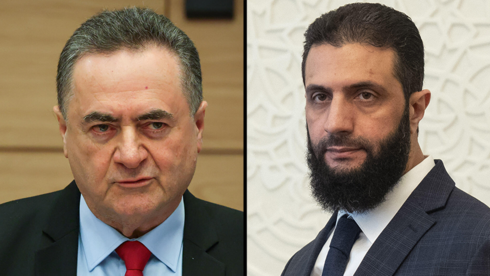
The following morning, on Wednesday, Israel’s Defense Minister Israel Katz warned Syrian leader al-Sharaa: "If you allow forces hostile to Israel to enter Syria and threaten Israeli security interests, you will pay a very heavy price." To clarify that the message was not solely directed at Syria's current ruler, Katz added: "The Air Force's activities yesterday at the T-4 airport in Hama and the Damascus area are a clear message and warning for the future. We will not allow harm to Israel’s security."
Katz refrained from mentioning Turkey by name, as Israel still hopes to avoid a direct confrontation and to reach an understanding with Ankara, potentially mediated by the United States and possibly Russia, regarding the division of influence and security arrangements in Syria. However, the bombing of four major military airports in Syria that night was a message directed at Turkey’s "sultan."
Erdoğan, his party, and his regime are ideologically aligned with the Muslim Brotherhood, of which Hamas is also a part. This is the primary reason for the longstanding hostility between Israel and Turkey, which became overt following October 7, particularly after the IDF began operations in the Gaza Strip.
3 View gallery

Defense Minister Israel Katz and Syrian interim President Ahmad al-Sharaa
(Photo: Mandel NGAN / AFP, AP / Mosa'ab Elshamy Avihu Shapira)
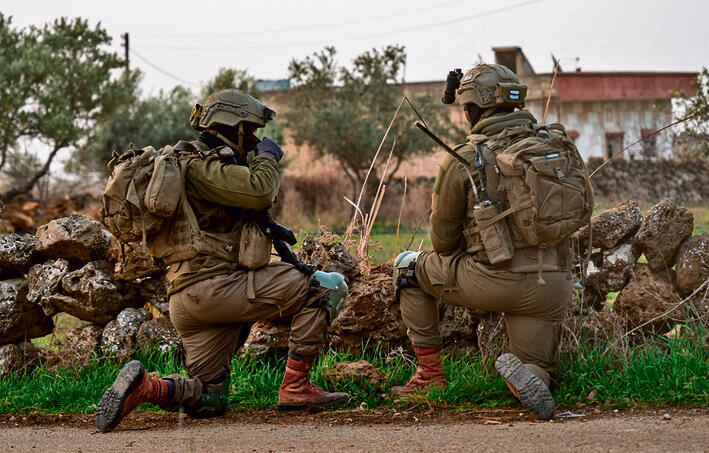
Learning from the events of October 7, the IDF took no chances and positioned itself in the buffer zone to prevent a scenario where Sunni jihadist militants would find themselves just a few hundred yards from Israeli communities in the Golan Heights. Simultaneously, the Air Force bombed strategic military infrastructure belonging to the Syrian army and Hezbollah throughout Syria, aiming to destroy stockpiles of weapons and prevent them from falling into the hands of Hay’at Tahrir al-Sham or, more importantly, Hezbollah.
This was Israel's first strategic move to counter the immediate threats posed by the collapse of the Assad regime in Syria. But within weeks, Israel noticed that Turkey intended to leverage its influence over the Sunni rebels to establish a military and economic foothold in Syria. Turkey has maintained a de facto security zone within Syrian territory for years, several miles wide, to prevent Kurdish militant groups (YPG) from aiding their counterparts in the Kurdistan Workers’ Party (Partiya Karkerên Kurdistanê, or PKK), which operates against the Turkish government in southeastern Turkey in pursuit of Kurdish autonomy.
Now, however, Erdoğan seeks to expand and entrench Turkey’s military and economic presence throughout Syria as part of the "neo-Ottoman" strategy Turkey has pursued over the last decade. This strategy aims to reestablish Turkey as a dominant regional power in the Middle East and a significant player on the international stage.
3 View gallery

Turkish President Erdogan
(Photo: Mustafa Kamaci/Turkish Presidential Press Office/Handout via REUTERS)
Turkey has exploited every political vacuum or weakness in the Middle East, especially since the Arab Spring, to establish footholds. Today, it has permanent military bases in eight countries across the Middle East and Africa, including northern Iraq, northern Syria, Qatar, Somalia, Chad and northern Cyprus.
Turkey’s intention to introduce air defense systems and radar to central Syrian airports poses a direct threat to Israel’s freedom of action in Syria. This freedom of action is vital not only to counter direct threats from Syria but also to maintain flight routes to destinations near and far in the Middle East, such as Iran.
Until the fall of the Assad regime, Russian monitoring forces in the border area with Israel prevented the Syrian army and local militants from clashing with Israel. However, if Turkish forces establish themselves in the area, operating drones, UAVs, and, most importantly, deploying air defense systems from airports like T-4, Homs, and Hama, Israel will have to carefully consider any action it takes to protect its citizens and sovereignty in the Golan Heights.
To send a clear message to Turkey, the Israeli Air Force carried out a series of bombings that completely destroyed the T-4 airport and its contents, preventing its use for a long time. While Turkey can rebuild these airports, the destruction was primarily intended to signal to Ankara that Israel would not allow such actions.
Israel’s long-term concern regarding Turkey is the potential creation of a Sunni Islamist axis aligned with the Muslim Brotherhood, led by Turkey, stretching through Syria, the Muslim Brotherhood in Jordan, Hamas and Islamic Jihad supporters in the West Bank, culminating in Gaza. Israel fears that this "Muslim Brotherhood axis" could replace the current "Shiite axis of evil" led by Iran.
Unlike Iran, with which Israel has no diplomatic ties or avenues for dialogue, Turkey is a NATO member, a close ally of the United States, and maintains strong ties with Russia. Israel and Turkey’s security and economic sectors are in constant contact and, despite Turkey openly harboring Hamas operatives from the West Bank, Israel has the ability to negotiate, send direct messages and even exert influence over Turkey.
In essence, Israel is proposing to Turkey a division of Syria into zones of influence under the auspices of the U.S. in the east, Russia along the western coastline, Turkey in the north, Israel in the south and east, and the temporary Syrian regime in the remaining areas—at least until a stable, elected government is established in Syria, which could take many more years.
