


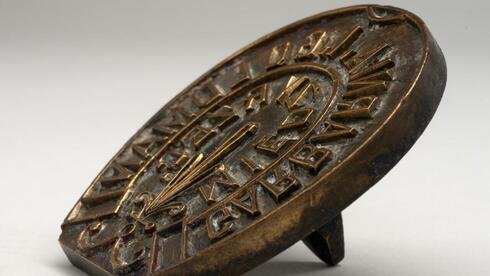
Thanks to connections between Israeli descendants of the town's Jewish community and local Polish residents, the stamp was returned to the family.
"It was a deeply emotional moment," said Yaakov Goldman, a descendant of the original factory owners. "To hold an item that was part of our great-grandfather's life's work — it truly brought closure." This year, the stamp was placed in the care of Yad Vashem, alongside an extensive family archive preserved over the years.
In September 1939, Nazi forces invaded Poland and soon reached Miedzyrzec. Persecution followed quickly, along with anti-Jewish decrees and property seizures. The Goldman family was forced to run the factory under German oversight for the Nazi war effort.
Work permits from 1941–1942 belonging to Hershko (Zvi) Goldman detail harsh working conditions. His 1942 identity card, stamped with a “J,” marked him as a Jew.
Only Hershko and his sister Sarah survived. Together with members of the Lampert family — including Tsina, who would later become Hershko’s wife — they hid in a pit beneath a barn in the ghetto.
Testimonies submitted to Yad Vashem, including a diary Hershko kept between 1944 and 1945, describe their struggle after Poland’s liberation, facing hostility from some locals and a constant threat from antisemitic gangs.
Hershko and Tsina married in February 1946 in their devastated hometown. Over a decade later, in May 1957, they made aliyah to Israel. Their son, Yaakov Goldman, eventually donated the rediscovered iron stamp, along with personal and family documentation, to Yad Vashem for safekeeping.
