


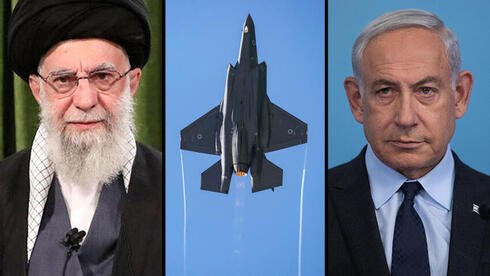
“Strike, Netanyahu, strike.” That’s the cry echoing behind the headlines of recent days. While Israel busies itself with trivialities, it’s ignoring the most significant strategic opportunity since its founding. Never have geopolitical conditions been more favorable for Israel to eliminate the modern-day Nazi threat once and for all.
3 View gallery
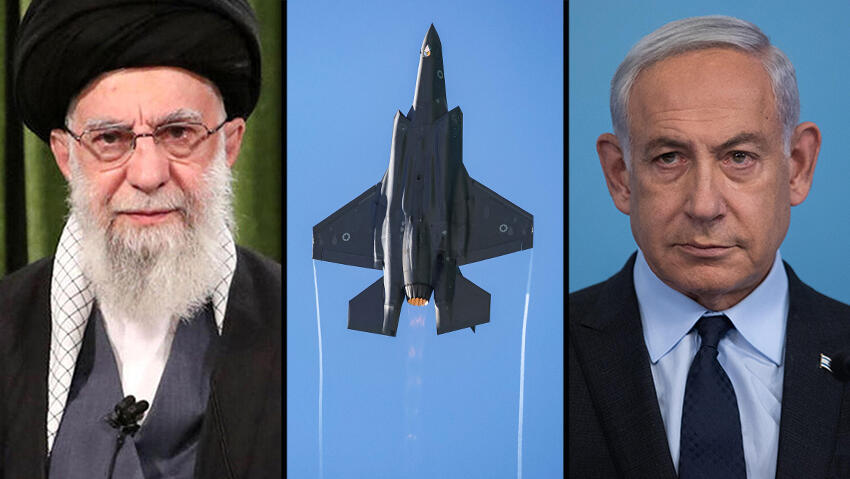
Iran's Supereme Leader Ali Khamenei, Israeli F-35 jet, Prime Minister Benjamin Netanyahu
(Photo: JACK GUEZ / AFP, AFP / HO / KHAMENEI.IR, Alex Kolomoisky)
It can’t supply its population with water. Lacking independent water production capabilities—such as desalination or efficient drilling—it has long relied on rainfall. But even the heavens have turned against the ayatollahs: winters are dry, lakes are vanishing and villages are collapsing. Thus emerged Iran’s newest phenomenon—“water refugees,” civilians fleeing their homes in search of something as basic as drinking water.
But the hangman's stage is already in sight. Even regime supporters are nearing open revolt. In response, Tehran has ramped up executions. They’ll never relinquish power voluntarily—and as long as they rule, like Hamas, they’ll remain fixated on Israel’s destruction.
A Churchillian moment
Winston Churchill stood alone against the Nazis long before the U.S. joined the war. He did everything in his power to convince President Roosevelt to intervene—without success. Isolationism has always been a cornerstone of U.S. strategic doctrine, not a Trump invention.
Since its founding, America has typically avoided initiating wars. Pearl Harbor didn’t trigger U.S. entry into WWII—Germany’s declaration of war on America did. Korea? The U.S. only returned after communist North Korea massacred 25 million people. Same with Vietnam.
Iraq, Afghanistan and the pursuit of Osama Bin Laden? Those were exceptions. The guiding principle remains: "Speak softly and carry a big stick." The military is a deterrent, not a hammer. Sometimes it works—but not with Hitler.
Roosevelt abandoned Churchill. President Donald Trump, in contrast, has not. Churchill didn’t break under the pressure. At one point, his war cabinet considered surrendering and opening talks with Germany.
Even the American ambassador in London worked secretly against him. But in a pivotal speech, Churchill changed the tide: “You don’t negotiate with a monster when your head is in its mouth,” he roared—and won the vote.

Today, Israel faces a similar moment. Ukraine embarrassed the U.S. with a bold strike on Russian bombers during American-led negotiations—but won global respect. The same would happen if Israel strikes Iran. Trump would be the first to applaud—followed by the rest of the world. Iran would likely retaliate, but just as in recent months, American forces would be compelled to respond in Israel’s defense.
Consider what U.S. ambassador Mike Huckabee said after the latest U.S.-Houthi deal: “America doesn’t need to tell Israel everything it does,” he said. “And Israel doesn’t need to tell America everything it does.” The message is clear: if Israel's existence is at stake, it must act. That’s why Trump was furious when he realized Israel wasn’t using his support to eliminate Hamas.
A duty to act
The U.S. is waiting for Israel to seize the moment as nuclear talks falter. It will never say so publicly—and rightly so. But that silence shouldn't be mistaken for disapproval. Israel must strike. But with a different strategy.
Destroying Iran’s nuclear infrastructure is important—but secondary. As long as the regime survives, the Nazi threat remains. When Churchill realized Nazi Germany would take control of France’s navy after France fell, he didn’t hesitate or wait for Roosevelt. At dawn, Britain’s Royal Air Force struck and destroyed the fleet of its own allies.
Likewise, Israel must act. Not just against nuclear sites—they’re too dispersed and fortified to be fully destroyed—but against the regime itself. That’s the primary target. Ports, communication hubs, command-and-control centers, cyberattacks—these can destabilize the regime and bring it down. Once that happens, the nuclear industry can be dismantled with ease.
This strategy mirrors Syria, where Bashar Assad’s regime had to be dealt with first. The hostages in Gaza would be freed immediately in exchange for the exile of Hamas’ surviving leadership.
Removing Iran’s regime would be historically equivalent to eliminating the Nazi threat. It would be a dramatic finale to a terrible war forced on Israel—and a victory of unprecedented scale. A geopolitical crescendo that would position Israel as the engine of the Persian Gulf states and the broader world.
 Rami Simani
As the world turns conservative and seeks moral clarity in the battle against darkness, it looks for leadership rooted in values—and finds it in Israel. The pressure will reverse: no nation in the region will want to be left without a peace, trade or cultural agreement with Israel.
Our biblical nation was destined to be a light unto the nations. Every week at the end of Shabbat, Jews recite the blessing: “[He] Who distinguishes between the holy and the profane, between light and darkness.” It’s time to turn off the lights—for the Nazis in Tehran.
