


2 View gallery

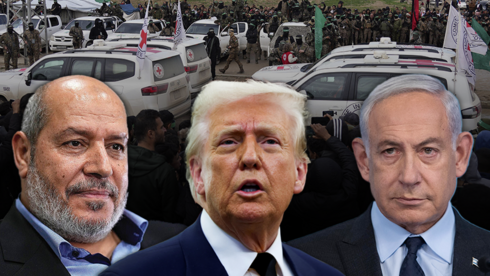
Hamas politburo member Khalil al-Hayya, U.S. President Donald Trump, Prime Minister Benjamin Netanyahu
(Photo: SkcJicnokl אלכס קולומויסקי, AP Photo/Abdel Kareem Hana, REUTERS/Evelyn Hockstein/Pool)
According to the report, the first day of the ceasefire would see Hamas release eight living hostages. On day 7, five bodies of hostages would be returned to Israel, followed by five more on day 30, two living hostages on day 50, and eight additional bodies on day 60.
As part of the arrangement, humanitarian aid would begin flowing into Gaza immediately, in accordance with an agreement signed on January 19 in coordination with the UN and the Red Crescent Society. Once the eight hostages are released on the first day, the IDF would withdraw from northern Gaza—according to pre-agreed maps.
A second withdrawal from the southern Gaza Strip would take place after day 7, following the transfer of the five bodies. Teams are expected to meet to finalize the withdrawal boundaries once the general framework is approved.
Formal negotiations would begin on the first day of the ceasefire, covering four main issues: continued hostage exchanges, long-term security arrangements in Gaza, post-war governance and the establishment of a permanent ceasefire. The proposal includes explicit guarantees of U.S. commitment to this process, with Trump’s envoy, Steve Witkoff, set to lead the negotiations.
The deal includes guarantees from the mediators—Egypt, Qatar and the U.S.—to ensure serious engagement with the talks. The ceasefire could be extended if needed. If a permanent deal is reached, all remaining hostages would be released.
Sources told Ynet that Trump is expected to personally announce the agreement, reaffirming his administration's leadership in securing a diplomatic end to the war.
