


The Islamic Republic’s continued enrichment activities, coupled with its open support for terror groups attacking Israel on multiple fronts, have pushed both Washington and Jerusalem to the brink of decisive action. In this volatile landscape, Congress is signaling that economic and political pressure will be maximized to weaken the regime — while simultaneously showing unprecedented support for the Iranian people before the military option becomes unavoidable.
In a landmark move signaling a new approach, the United States Congress has introduced two parallel bills: the Maximum Pressure Act and the Maximum Support Act. Together, they represent a dual-pronged approach aimed at dismantling the Islamic Republic’s oppressive infrastructure while empowering the Iranian people—an overwhelming majority of whom seek an end to the regime that has ruled their nation with brutality, corruption and terror for over four decades.
The Maximum Pressure Act, introduced by Rep. Zach Nunn (R-IA) and co-sponsored by dozens of bipartisan lawmakers, codifies and expands sanctions on the Iranian regime. It targets the supreme leader, sectors of the Iranian economy, the IRGC’s ballistic missile program and foreign entities aiding the regime. Its core objective is to systematically erode the financial capabilities that allow the Islamic Republic to fund terrorism, oppress its citizens and project military force across the region. “This legislation delivers the toughest sanctions ever proposed by Congress,” said Rep. Nunn. “It’s time to gut Iran’s ability to terrorize its people and the region.”
Complementing this effort is the Maximum Support Act, introduced by Reps. Joe Wilson (R-SC) and Jimmy Panetta (D-CA), which seeks to empower the Iranian people directly. The bill includes provisions for expanding internet access in Iran, seizing regime-controlled assets abroad to fund pro-democracy movements and protecting Iranian dissidents. It was developed with critical support from the National Union for Democracy in Iran (NUFDI), a prominent Iranian-American organization advocating for secular democracy and human rights.
2 View gallery

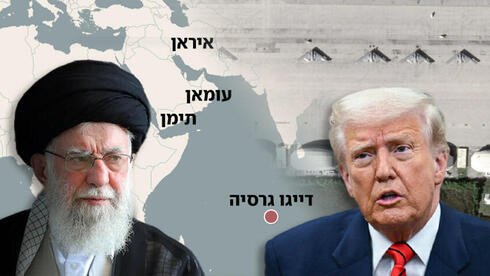
Iranian Supreme Leader Ayatollah Ali Khamenei, US President Donald Trump
(Photo: REUTERS/Mohammed Yassin, Iranian Leader's Press Office, Mandel NGAN / AFP)
This dual-track policy also carries significant implications for Israel. As the Islamic Republic continues to arm and direct its terror proxies—Hezbollah in Lebanon, Hamas in Gaza and Shiite militias in Syria and Iraq—the ability to cut off Tehran’s funding and coordination networks directly enhances Israel’s security posture. Israeli officials, including former National Security Council members, have welcomed the Maximum Pressure Act as an essential step in weakening Iran’s regional grip. Moreover, by targeting the regime’s digital censorship and offering tools to civil society actors, the Maximum Support Act also aligns with Israeli and Western interests in promoting long-term stability through democratic reform.
 Emily SchraderPhoto: Saskia Pantell
Dr. Jonathan Spyer, an Israeli Middle East analyst at the Jerusalem Institute for Strategy and Security, put it succinctly: “This isn’t just about punishing a rogue regime—it’s about tipping the scales in favor of a people that has suffered for too long. If enforced fully, these bills could change the calculus in the region.”
Skeptics of U.S. sanctions have long warned that economic pressure alone may not bring down the Islamic Republic. Yet, this new strategy breaks from past efforts by pairing sanctions with meaningful engagement and resources for Iran’s democratic opposition. With a collapsing currency, deepening protests and unprecedented international isolation, the regime is already showing signs of fatigue. The introduction of both bills could very well accelerate a historic shift from dictatorship to democracy.
In the broader context of Israel’s war with Iranian-backed proxies and its ongoing defense against Tehran’s regional ambitions, the timing of these bills could not be more significant. They send a clear message to both adversaries and allies: the United States is not only committed to defeating terrorism, but also to standing with the Iranian people in their struggle for freedom—and with Israel in its fight for survival.
